Thursday, 26 January 2017

Script For Thriller Opening

Here is our script for our thriller opening 


Lydia is sitting in her bedroom on her phone when she gets a text from her best friend Mia. Here is their text message conversation.

Mia: Hey, you alright? Heard you've been having flashbacks or something? 
Lydia: Hello, and yeah they're of when I was kidnapped... I just can't stop thinking about it. 

Lydia starts having a flashback of when she was kidnapped. While she has been having her flashback Mia has been sending messages as she is worried.

Mia: I'm always here
         Lydia?
         Hello?
         Are you okay?
         Lydia, are you there?
        Whats happened?
         HELLO??
Lydia: Sorry, Flashback again!
Mia: Oh, can we meet soon in the park? We can talk.
Lydia: Yeah sure, just leaving. 

Lydia puts her phone down and we then see Lydia sitting on the park bench waiting for Mia to arrive. As Mia is approaching, Lydia backs up as she is afraid of the figure walking towards her. She then falls to the floor and Mia runs over to help her.

Mia: Lydia! What’s wrong? Come on, sit here.

Mia sits down on the bench with Lydia.

Mia: What happened?
Lydia: I thought you were.. you know.
Mia: Oh, was it what I’m wearing, I’m sorry I didn’t think
Lydia: No no it’s fine, it’s not your fault, I’m just still not over what happened
 Mia: What happened when you were taken? What did they do to you?

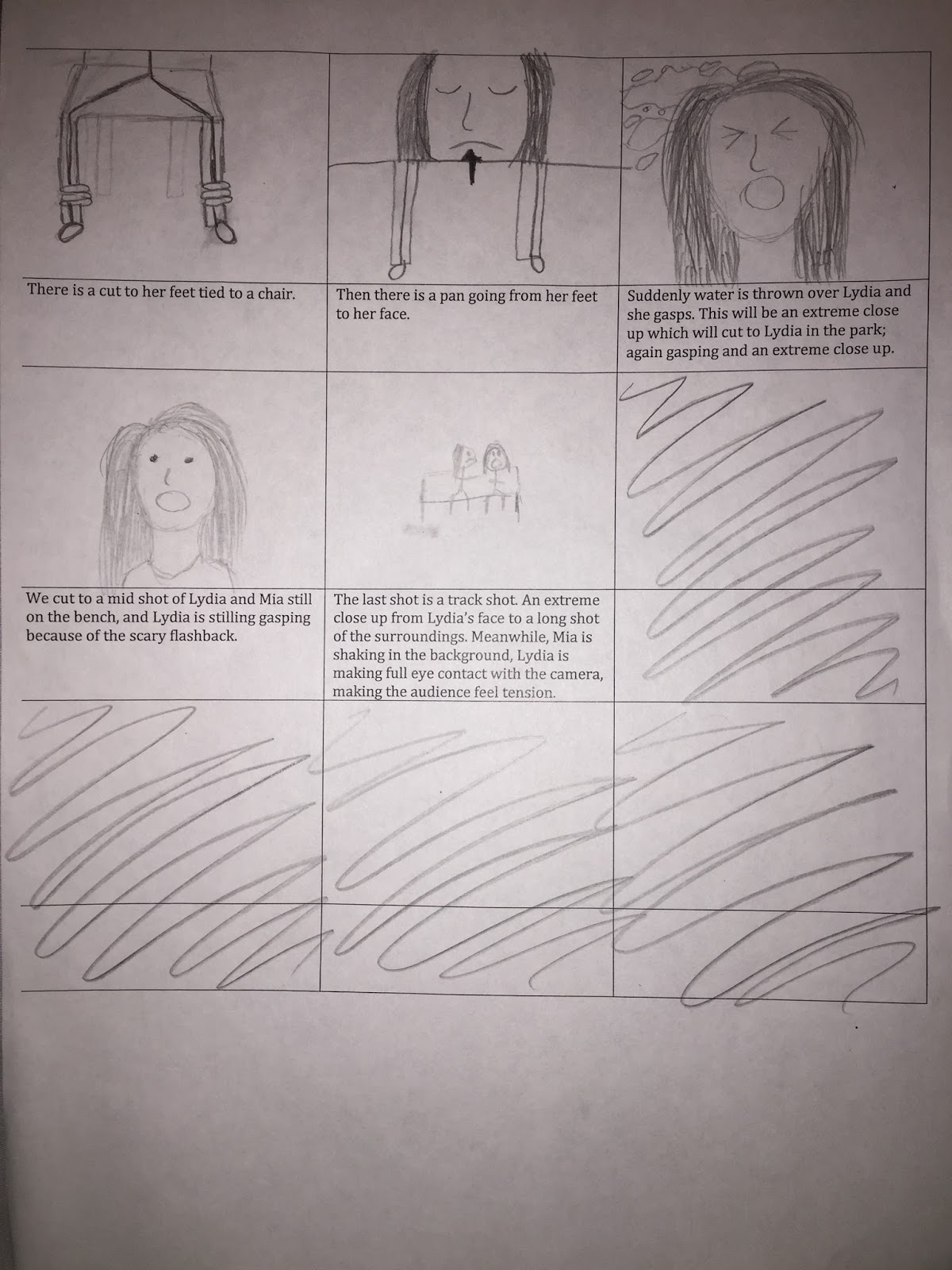
 Lydia has a flashback where she is tied to a chair in the middle of a room, there is no talking in this scene but she does gasp at the end when water is thrown over her. The flashback is over and she continues to gasp, scaring Lydia and is now frozen with fear.


Mia: Lydia? LYDIA?! Are you okay? What happened?! Talk to me. Please Lydia says something! What did you see? LYDIA!

Storyboard For Our Thriller Opening

Once we decided our story line for our thriller opening I begun creating and typing up a detailed storyboard. This outlined what camera angles we would use, what cuts we'll be using, what costumes our characters will be wearing, what non-diegetic sounds and music will be added etc. After typing up everything we then printed them off and each person in our group got a sheet. Where we each drew the shots we are going to use in that particular scene when filming. This would make it eaiser for us when it came to filming, so we wouldn't get confused.


Monday, 23 January 2017

The Sixth Sense Analysis

After watching the film 'The Sixth Sense' there were many scenes where there was an increase in tension and suspense in order to scare the audience and put them on edge. This is due to the produces use of Mise en scene, Camera angles, Editing, Sound. Here are some examples of scenes where this was clearly shown.


The first scene I have chosen is of one of the main characters Cole. It is clear from this scene that he is in some distress and the use of the extreme close up (camera angle) emphasises this, in order for the audience to sympathise with that character. Due to this extreme close up we also get to see the tears in his eyes and how they fall down his face which increases the audiences concern for Cole. In addition to this the use of Mise en scene also emphasises the feeling of fear and darkness which the producer is trying to create. For example; the clothing he is wearing is quite dark and dull which links to his situation and how the ghosts/darkness is all around him or how he has been touched by the darkness. Also, the use of the lighting could also highlight the fact that Cole is being pulled into the evil and ghostly world, due to half his face being light and half being in the dark.


The next scene I have chosen is one of a character called Vincent. This seen was meant to come across as frightening and creepy. This was achieved by using a Mid shot (camera angle) which allowed the audience to see Vincent's body language. This suggested that he was in some distress and shows fear, due to his arms being wrapped around himself, which grasps the audience attention and makes us fear for the other characters. Moreover, the use of non diegetic music during the scene increases the felling of fear whilst also increasing the tension of the scene (which is meant for the audience).  

This next scene is interesting because it has a hidden meaning in it. During the film we find out that the mother (the woman in the picture) is evil as she was making her daughter sick. In this scene the use of Mise en scene is important, because of the use of her red clothing and red lipstick. The colour red can be associated with evil, the devil, blood etc. In addition to this, considering she is the only person in the room who is wearing red this emphasises the idea of her being evil and unforgiving. 

AS Media | Preliminary Task Evaluation


Here is our final edit of our preliminary task which we all planned, filmed and edited ourselves. We made sure that we used a variety of camera shots including close ups, mid shots, over the shoulder shot etc. In addition to this we also used all three different features in our task, which are Shot Reverse Shot, 180 Degree Rule and Match on Action. All of these shots were used effectively in order to make the story line flow better and to help the audience understand it better.


When filming we made sure that everyone had a chance to film in order for us all to gain skills, in preparation for our thriller opening.


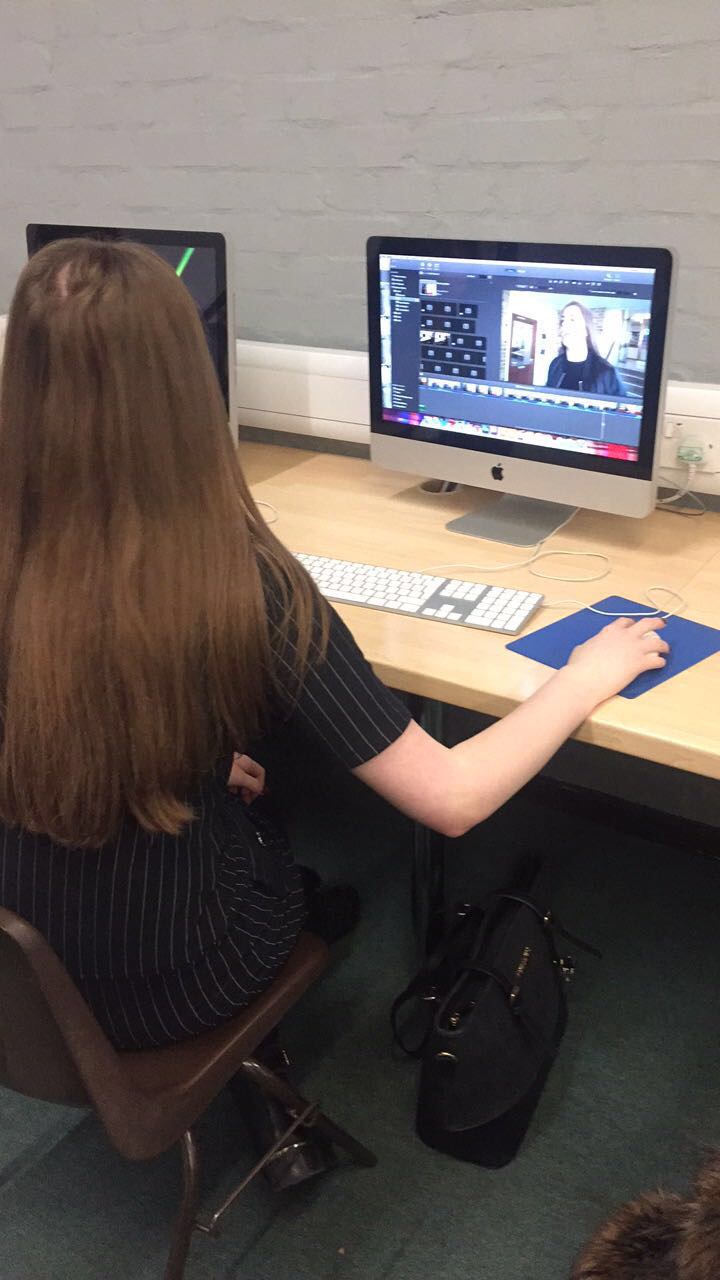
When editing, again, we made sure everyone had a chance to edit our footage. This would help us all develop our skills for the thriller opening.

Wednesday, 16 November 2016

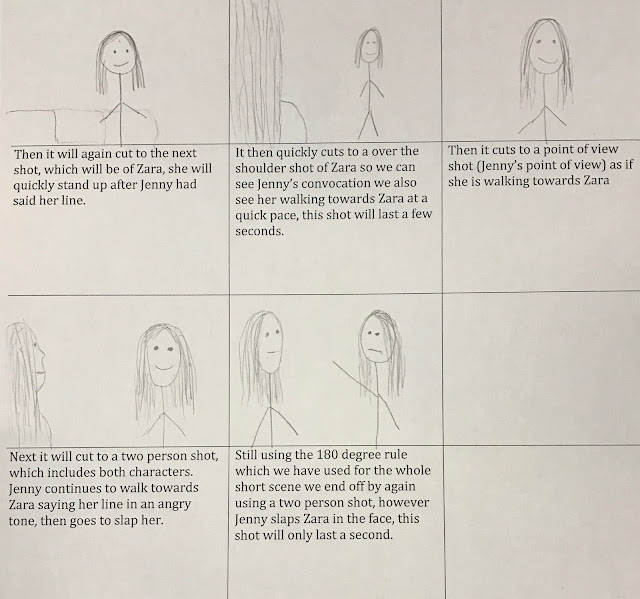
Our Script and Storyboard For Our Preliminary Task

For our 25 second Film (Our Preliminary Task) we are filming an argument between two friends over a boy. The genre of this type of film we have chosen is a comedy/teen film. There are two characters in our film who will be played by Gabrielle (Zara) and I (Jenny). The script below is what will happen in  the 25 seconds.

Our Script:

Jenny opens the door and walks down the stairs where Zara is sitting directly opposite. Zara looks up from her phone and sees Jenny standing at the opposite side of the room.
Zara: Oh, hey Jenny
Jenny: Texting Callum are we?
Zara: What?


Jenny begins to walk slowly towards Zara, who is still sitting down.


Jenny: You and Callum. I know you like him, and I know you walked home with him yesterday!


Zara stands up from her seat, shocked by Jenny's accusation. 
Zara: Yes I did walk with him but only as friends. I don't like him in that way.
Jenny: You know how much I like him Zara. How could you do this to me!
Zara: Your acting crazy, I only walked home with him. I wouldn't do that to you. Come on sit down and we'll talk.
Jenny: Crazy? Crazy! Oh I'll show you crazy.


Jenny then slaps Zara across the face and it cuts to a black screen.


Our Storyboard:


Friday, 11 November 2016

Our 3 Different Features

For our prilimainary task we will be including 3 different features which are 180 degree rule, Match on Action and Shot Reverse Shot. We will be including all 3 of these in our short film.

Shot Reverse Shot:

A Shot Reverse Shot is a film technique where one character is shown looking at another character (often off screen), and then the other character is shown looking back at the first character. Common uses for this shot is when the characters are having an argument because when edited they can be reversed quickly in order to make the argument look for intense. This is how we are going to use this particular shot.


An example of a Shot Reverse Shot is at the beginning of the film 'Hunger Games' when one character is having an interview on a TV show and the shots are reversed from that character and the the interviewer. This would show you when each person is talking (when one is asking a question and the other answers.


180 Degree Rule:

A 180 Degree Rule is also a film technique which is a cinematography guideline that states that two characters in a scene should maintain the same left/right relationship to one another. When the camera passes over the invisible axis connecting the two subjects, it is called crossing the line and the shot becomes what is called a reverse angle. We can use this technique in our film when our two characters are having their argument, this will ensure that our audience will not get confused. 


An example of the 180 Degree Rule would be in the film 'The Shining'. However the director of this film ended up breaking this rule in order to give a thrilling and dramatic effect towards the audience, as the film was a thriller film. This kind of shot is commonly used when two characters are fighting or arguing in order to prevent the audience getting confused. However in some very rare cases, like 'The Shining', the rule is broken which ends up going with the plot and the type of genre the film is.


Match on Action:

Finally, the last film technique is called Match on Action, which refers to film editing and video editing techniques where the editor cuts from one shot to another view that matches the first shots action. We will achieve this in our film when our first character walks into the room towards our second character who will be sitting down.


An example of a Match on Action is in the series 'Friends' where the character Chandler opened the door. The camera was facing him as he talked to the people at his door, then as he closed the door the camera angle switched and was now in the room facing the door as it closed. Match on Action enables the audience to see everything that happens in a scene, in order to understand the program fully.

Wednesday, 9 November 2016

Preliminary Task

For my preliminary task and for my group I am with Chelsea Stevens, Olivia Markey and Gabrielle Phillips and we have begun creating our short film which will last around 25 seconds. For our film we have decided to base it on an argument between two friends, which would enable us to incorporate the 3 different features effectively. These include Match on Action, 180 Degree Rule and Shot Reverse Shot. We have begun planning our film by thinking about how we are going to include our 3 different features as well as including other shots, movements etc. in our film.